
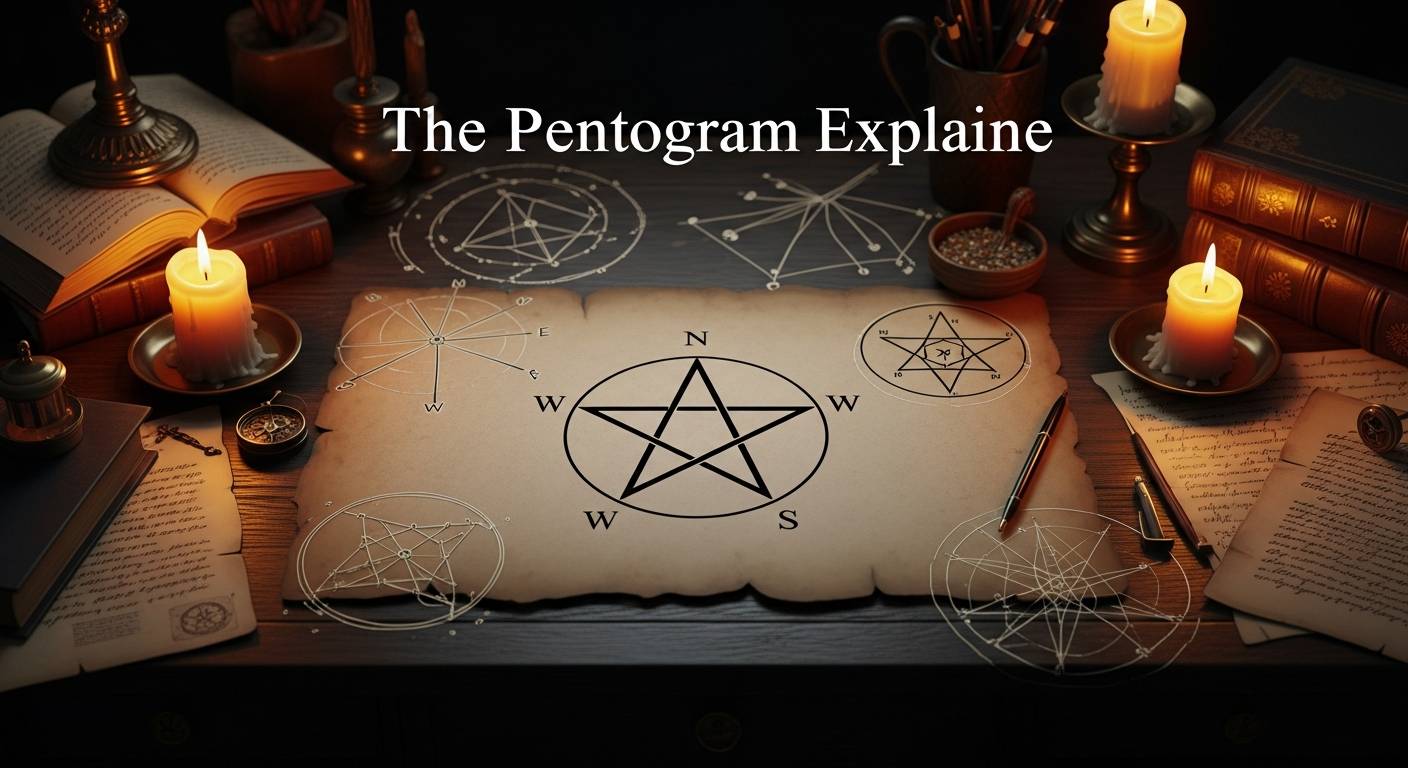

The pentagram is one of the most recognisable and misunderstood symbols in the world. It is a five-pointed star drawn with continuous lines, simple enough to be sketched in seconds, yet layered with centuries of religious, magical, protective, mathematical, and cultural meaning.
For some, the pentagram represents protection, balance, and spiritual order. For others, it suggests witchcraft, occult ritual, Satanism, or forbidden knowledge. Its reputation depends heavily on context, especially whether the star is upright or inverted, where it appears, and which tradition is using it.
The pentagram has been used in ancient symbolism, Christian imagery, ceremonial magic, folk protection, modern Paganism, Wicca, Satanic symbolism, and popular horror. That long journey has made it powerful, but also easy to misread. Its meaning cannot be reduced to one tradition or one modern stereotype.
What the Pentagram Looks Like
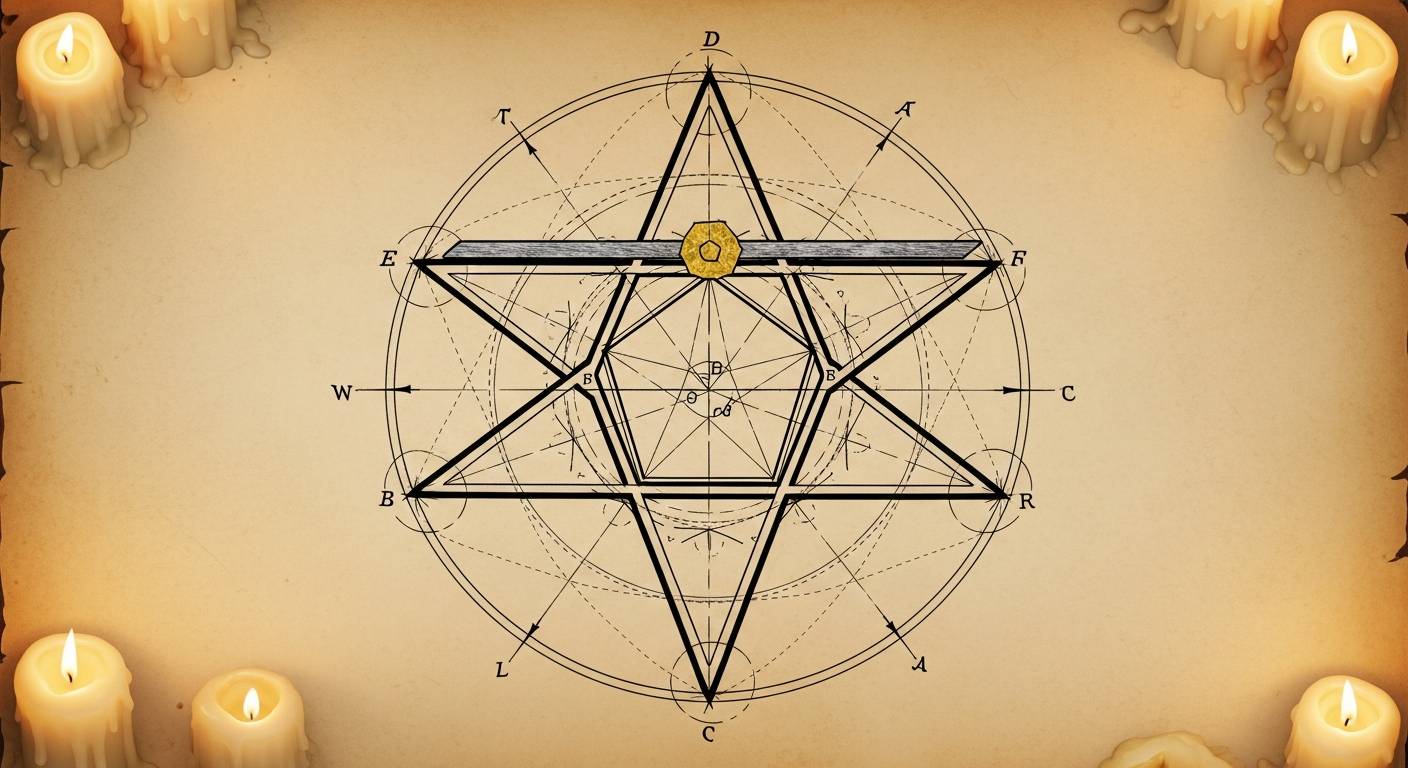
A pentagram is a five-pointed star made from five straight lines. Each line crosses another, creating a smaller pentagon in the centre. The design is geometric, balanced, and visually memorable. It can be drawn upright, with one point facing upward, or inverted, with two points facing upward.
The word pentagram refers to the star itself. A pentacle usually refers to a pentagram enclosed within a circle, although the terms are often used loosely in everyday speech. In magical and religious contexts, that circle can represent unity, protection, containment, or sacred boundary.
The symbol’s power comes partly from its simplicity. Five points can be linked to the human body, the senses, the elements, wounds, directions, virtues, or forces of nature depending on the tradition interpreting it. The same basic shape can therefore carry very different meanings.
Ancient Roots of the Five-Pointed Star
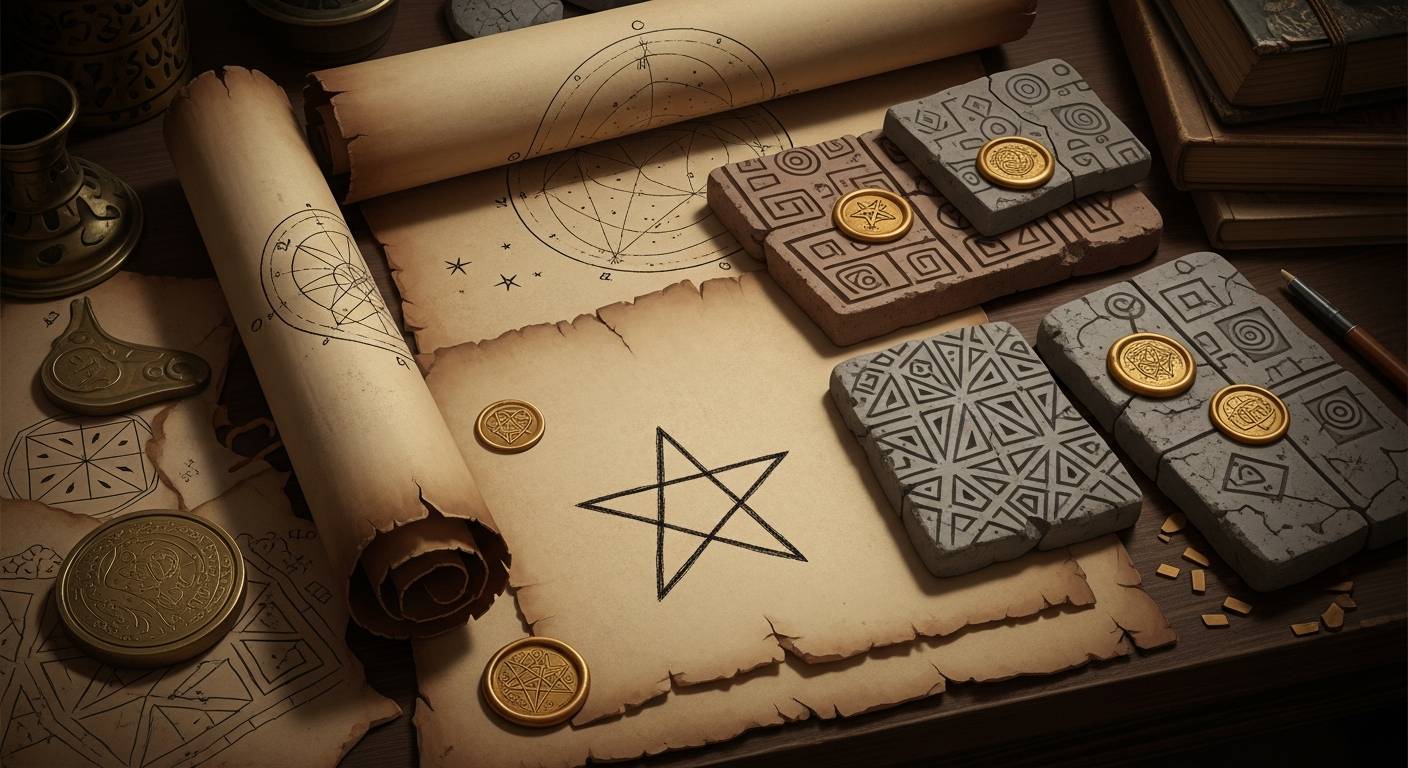
The five-pointed star is ancient, and no single culture can claim it as a fixed universal symbol. Versions of the shape appear in early art, marks, seals, and decorative systems across different regions and periods. Its appeal is easy to understand: it is symmetrical, memorable, and mathematically elegant.
In some ancient contexts, star-like symbols were linked with the heavens, planets, protection, or sacred order. In others, the shape functioned as a mark, ornament, or diagram. The problem with tracing the pentagram is that the same shape can appear in many places without always meaning the same thing.
That ambiguity is part of the pentagram’s history. It is not a symbol with a single clean origin. It is a form that cultures repeatedly found useful because it could represent order, light, protection, the body, the cosmos, or hidden knowledge.
The Pentagram and Pythagorean Symbolism
One of the most important early associations of the pentagram comes from the Pythagoreans, a philosophical and mathematical tradition in ancient Greece. The pentagram was admired for its geometry, especially the proportional relationships hidden within its lines. It became a symbol of harmony, health, and mathematical order.
The shape contains repeated ratios and internal symmetry. To people who saw number, proportion, and geometry as reflections of cosmic truth, the pentagram could suggest more than ornament. It showed that beauty and order were built into the structure of the world.
This mathematical background helps explain why the pentagram later appealed to esoteric traditions. Occult symbolism often treats geometry as a bridge between the visible and invisible. The pentagram’s clean form made it a natural candidate for diagrams of balance, protection, and hidden structure.
Christian Meanings of the Pentagram
Before the pentagram became widely associated with witchcraft or Satanism in popular culture, it also carried Christian meanings. In some medieval Christian interpretations, the five points were linked with the five wounds of Christ. The symbol could therefore suggest sacrifice, salvation, and divine protection.
The pentagram also appeared in moral and allegorical settings. Its five points could be interpreted through virtues, senses, or aspects of spiritual discipline. Like many medieval symbols, it was flexible and could be read through theological, moral, or mystical frameworks.
This older Christian use is important because it challenges the modern assumption that the pentagram has always been anti-Christian. Its reputation changed over time. A symbol once used in protective and religious contexts later became feared by many people because of changing cultural associations.
The Pentagram as a Protective Symbol
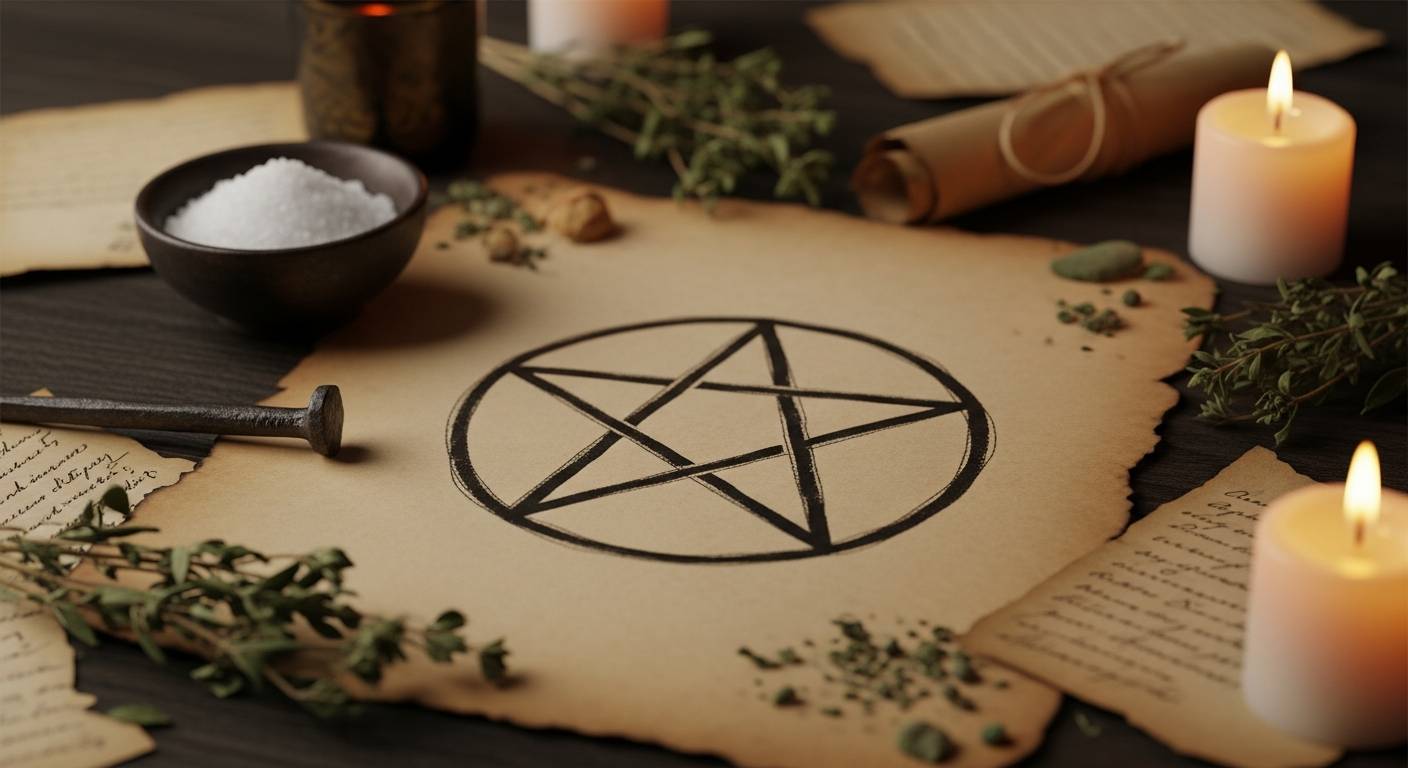
Across many magical and folk traditions, the pentagram has been treated as a protective mark. It has appeared on objects, buildings, charms, diagrams, and magical tools as a way of marking sacred or defended space. Its enclosed geometry made it especially suitable for ideas of containment and protection.
In folk belief, protective symbols often work because they create a boundary between the ordinary world and harmful forces. The pentagram’s interlocking lines can be read as a visual barrier, a sign of order placed against chaos. When enclosed in a circle, the protective meaning becomes even stronger in many interpretations.
The symbol’s protective reputation survived into ceremonial magic and modern Pagan practice. In those settings, it may represent balance among elements, spiritual focus, or the marking of sacred space. The exact meaning changes by tradition, but protection remains one of its most persistent associations.
The Five Elements and Magical Balance
In many modern occult and Pagan interpretations, the five points of the pentagram are linked with the elements. Four points may represent earth, air, fire, and water, while the fifth represents spirit. This creates a symbolic map of the world as a balanced structure of material and spiritual forces.
When the pentagram is shown upright, with one point at the top, it is often interpreted as spirit rising above or ordering the material elements. This does not make every upright pentagram religious in the same way, but it explains why the upright form is often associated with protection, harmony, and spiritual balance.
The elemental reading is one of the reasons the pentagram remains important in Wicca and other modern magical traditions. It offers a compact symbol for nature, body, mind, spirit, and the relationship between the human world and the unseen.
The Inverted Pentagram
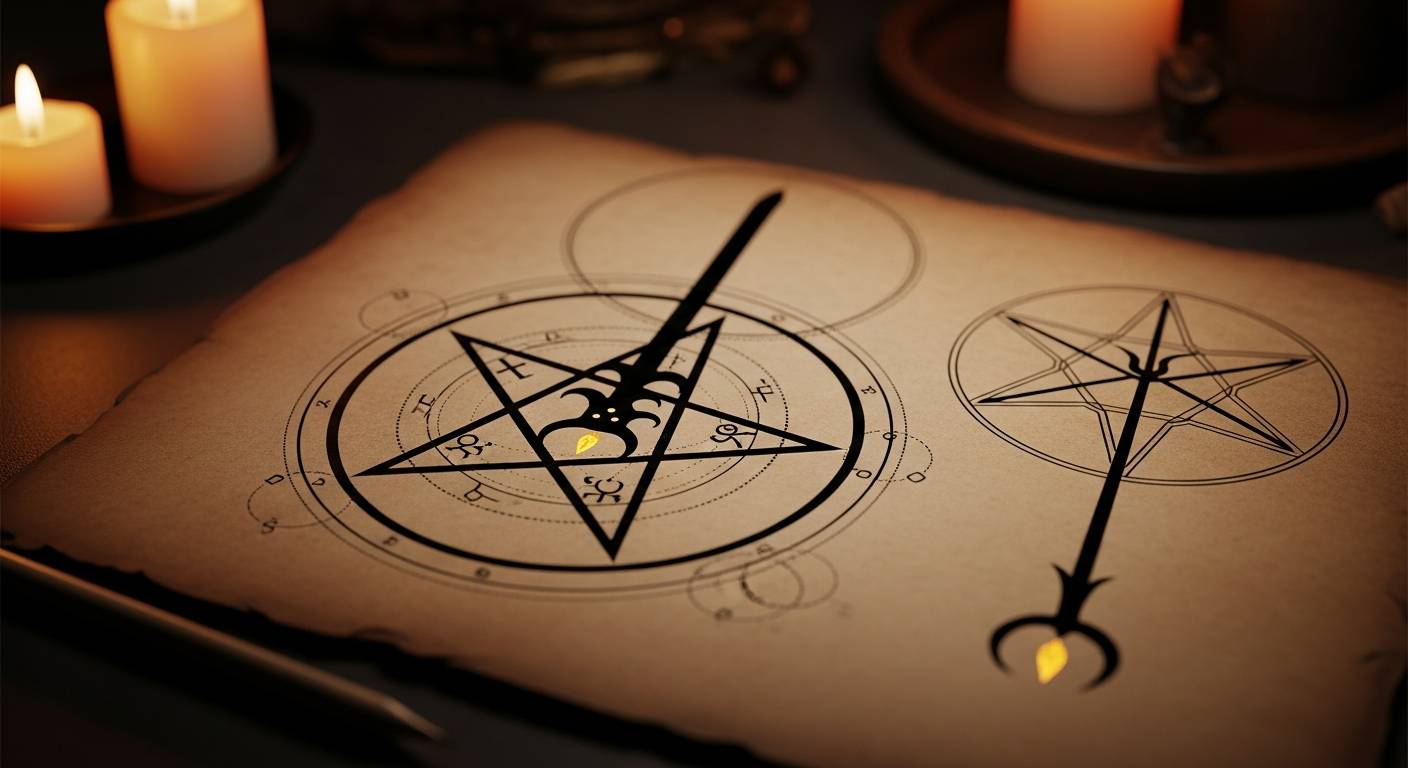
The inverted pentagram is the same five-pointed star turned so that one point faces downward and two points face upward. This shift in orientation dramatically changes how many people read the symbol. In some occult interpretations, the inverted form suggests matter over spirit, descent, instinct, or reversal.
In modern culture, the inverted pentagram is often associated with Satanism or dark occult imagery. This association became especially strong when the inverted star was combined with a goat’s head in the modern Sigil of Baphomet. In that design, the goat’s horns align with the two upper points, while the beard points downward.
Even so, inversion does not automatically create one universal meaning. Symbols change across traditions. The inverted pentagram can be used for shock, ritual identity, philosophical reversal, or popular horror imagery. Its meaning depends on context rather than orientation alone.
The Pentagram in Wicca and Modern Paganism
In Wicca and many modern Pagan settings, the pentagram or pentacle is commonly used as a symbol of nature, protection, elemental balance, and spiritual identity. It is often worn as jewellery, placed on altars, used in ritual tools, or displayed as a sign of religious belonging.
For many practitioners, the pentagram is not a symbol of evil or danger. It represents a worldview in which the natural world, the body, the elements, and spiritual experience are interconnected. The circle around the star often strengthens the sense of unity and sacred boundary.
Misunderstandings around Wiccan pentagrams have been common because popular culture often treats any occult-looking symbol as sinister. In reality, modern Pagan use of the pentagram is usually closer to protection and reverence for nature than to the frightening meanings assigned by horror films or moral panic.
The Pentagram in Ceremonial Magic
The pentagram also holds an important place in ceremonial magic, where it is used as a symbol of elemental order, spiritual authority, and the structuring of sacred space. In this context, the symbol is part of a larger language of ritual geometry, divine names, directions, and symbolic correspondences.
Ceremonial magic often treats symbols as tools for focus and alignment. The pentagram can represent the relationship between the magician, the elements, and the larger order of the cosmos. Its value lies not only in its shape, but in the system of meaning built around it.
This ceremonial use helped shape the pentagram’s modern occult reputation. To outsiders, ritual diagrams and magical symbols can look mysterious or threatening. To practitioners and historians of esotericism, they often form part of a structured symbolic language rather than random signs of darkness.
Satanic Symbolism and Popular Fear
The pentagram’s association with Satanism is one of its most famous modern meanings, but it is not the whole history of the symbol. The connection is strongest with the inverted pentagram, especially when combined with goat imagery, dark ritual aesthetics, or explicitly Satanic contexts.
Modern Satanic use often treats the inverted pentagram as a sign of rebellion, inversion of traditional religious authority, individualism, or opposition to imposed spiritual guilt. In popular horror, the same symbol is often used more simply as a visual shorthand for evil, danger, or forbidden ritual.
This has caused many people to treat every pentagram as Satanic, even when the symbol appears in protective, Christian, Wiccan, mathematical, or decorative settings. That confusion is one of the main reasons the pentagram remains so controversial.
Common Misunderstandings
The most common misunderstanding is that the pentagram has one fixed meaning. It does not. The symbol has been used in ancient, mathematical, Christian, magical, Pagan, Satanic, artistic, and popular contexts. A pentagram on a medieval church carving does not mean the same thing as a pentagram in a horror film.
Another misunderstanding is that upright and inverted forms are always morally opposite. Orientation matters, but it is not the only factor. Context, tradition, design, and intent matter just as much. A star inside a protective circle, a goat-headed inverted pentagram, and a decorative five-pointed star belong to different symbolic settings.
The pentagram is also often confused with the pentacle. While the words overlap in modern use, the pentacle usually refers to a pentagram inside a circle, especially in magical or Pagan settings. That distinction is useful, even though it is not always applied consistently.
Why the Pentagram Still Matters
The pentagram still matters because it is one of the clearest examples of how symbols change over time. The same five-pointed star has represented health, geometry, divine wounds, protection, elemental balance, magical order, religious identity, rebellion, and fear.
Its power comes from that layered history. People react strongly to the pentagram because it carries more than one story. It can appear sacred in one setting, protective in another, occult in another, and threatening in another. Few symbols show so clearly how meaning is shaped by culture, belief, and interpretation.
The pentagram is not merely a sign of darkness, nor is it only a harmless geometric shape. It is a symbol with a long and complicated life, one that continues to sit at the crossroads of religion, magic, mathematics, folklore, and popular imagination.