

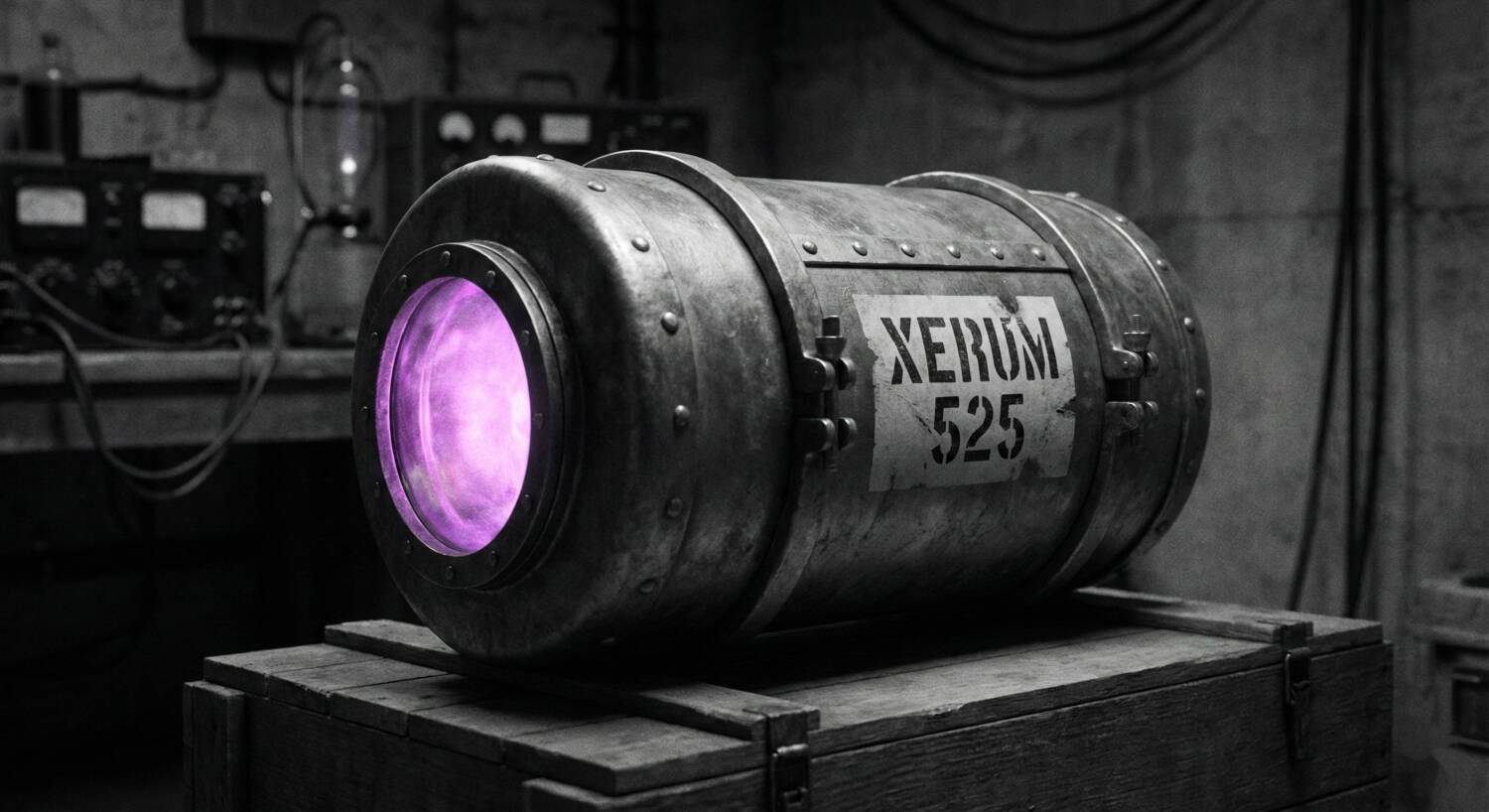
Few wartime legends stir as much fascination as Die Glocke, the so-called Nazi Bell. Said to be one of the Third Reich’s most secret scientific projects, this device has been described as both a potential anti-gravity engine and a time manipulation experiment. If even a fraction of the rumors are true, it would have required an enormous, possibly exotic, power source. So what could have possibly driven such a machine in the 1940s?
The story of Die Glocke comes mostly from post-war testimonies and obscure documentation allegedly linked to SS General Hans Kammler, who oversaw many of Germany’s top-secret “Wunderwaffe” (Wonder Weapons) programs.
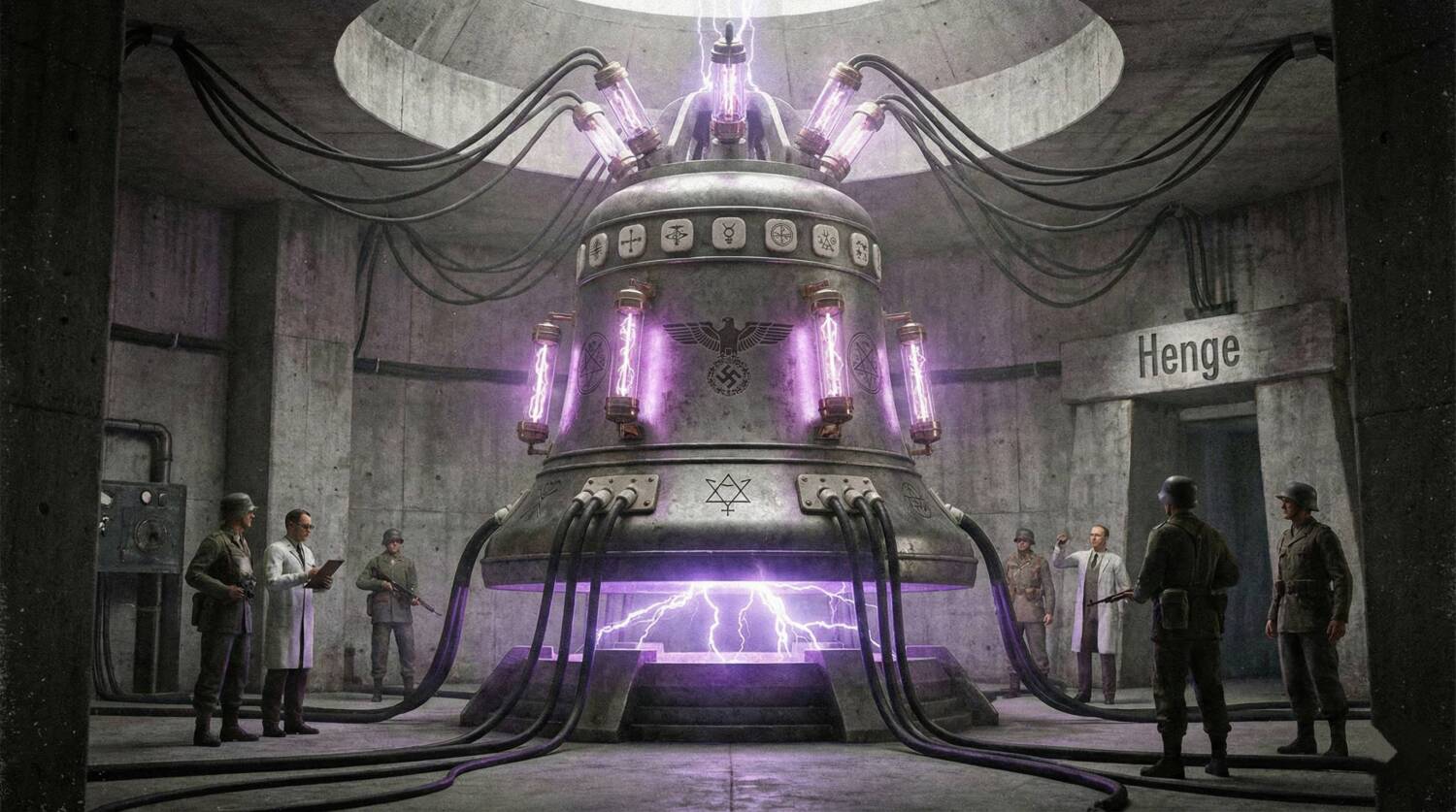
The device was reportedly bell-shaped, constructed of heavy metal, and measured about nine to twelve feet high and roughly five feet wide. It allegedly contained two counter-rotating cylinders filled with a glowing metallic or mercury-like substance known as “Xerum 525.”
Witnesses described frightening effects when the machine was activated: an intense purple-blue light emitted from the core, severe radiation burns and illness in nearby workers, and temporary distortions in time or gravity, with small test animals allegedly decaying rapidly or freezing in place. The device was supposedly tested deep in a Wenceslas mine complex near the Czech border, under tight SS control. Many believe it was either moved or destroyed before the end of the war, with Kammler himself disappearing without a trace.
The Practical Possibilities: What the Germans Actually Had
If we strip away the mystique, the Nazis did possess some highly advanced power technologies for the era. Several real systems could, in theory, have powered an experimental machine like Die Glocke:
- High-Voltage Generators: German laboratories had access to powerful Van de Graaff and Marx generators, capable of creating millions of volts in pulsed discharges. Such equipment could have been used to energize the rotating cylinders or produce strong electromagnetic fields.
- Hydroelectric Power from the Region: The Sudetenland and Silesia, where the Bell was supposedly tested, were home to large hydroelectric facilities. These could have provided the continuous electrical load necessary for experimental runs lasting several minutes or more.
- Nuclear Research Spin-Offs: The German Uranverein (Uranium Club) conducted early nuclear research under scientists like Heisenberg and Diebner. While they never achieved a sustained chain reaction, their work involved uranium isotopes and heavy water, both capable of generating powerful but unstable bursts of energy. It’s not impossible that a subcritical nuclear experiment was adapted as part of Die Glocke’s design.
- Mercury Plasma Experiments: Mercury was used in many high-voltage and plasma experiments at the time. If Xerum 525 was some form of doped or irradiated mercury compound, it might have served as a conductive plasma medium, allowing for intense electromagnetic interactions when spun at high speed — possibly giving rise to the strange effects witnesses described.
The Speculative Side: Theories Beyond Known Science
This is where the mystery deepens. Some researchers, including Nick Cook and Henry Stevens, believe Die Glocke could have been an attempt to tap into torsion fields, zero-point energy, or anti-gravitational forces — theories that even today sit on the edge of accepted physics.
In this speculative view, the Bell’s power source was not merely electrical. The rotation of charged, dense material (like mercury plasma) within powerful electromagnetic fields could have interacted with spacetime itself, releasing energy from the vacuum.
Others suggest it was part of a nuclear propulsion experiment, similar in concept to what the United States explored later with Project Orion or nuclear isomer technology, only decades ahead of its time. If so, the radiation and light effects reported might not have been mystical at all — just an uncontrolled reaction from an early, crude nuclear process.
Still, there is no conclusive proof. The combination of missing records, vanished scientists, and the destruction of secret SS facilities leaves the truth frustratingly out of reach. Yet the consistent pattern of testimonies, along with the technological feasibility of at least some components, keeps the legend alive.
What It Might Have Been
Taking everything together — the historical context, the known science, and the enduring rumors — the most plausible answer is that Die Glocke was an advanced electromagnetic or nuclear experiment, possibly involving rotating mercury plasma and extremely high voltage.
Whether it was a weapon, a propulsion test, or something far stranger remains uncertain. But whatever was built in that hidden Silesian mine clearly pushed the limits of 1940s technology, and perhaps, the boundaries of what we still understand about energy itself.
 Conspiracies & Cover-Ups
 Die Glocke: Nazi Germany's Secret Weapon