

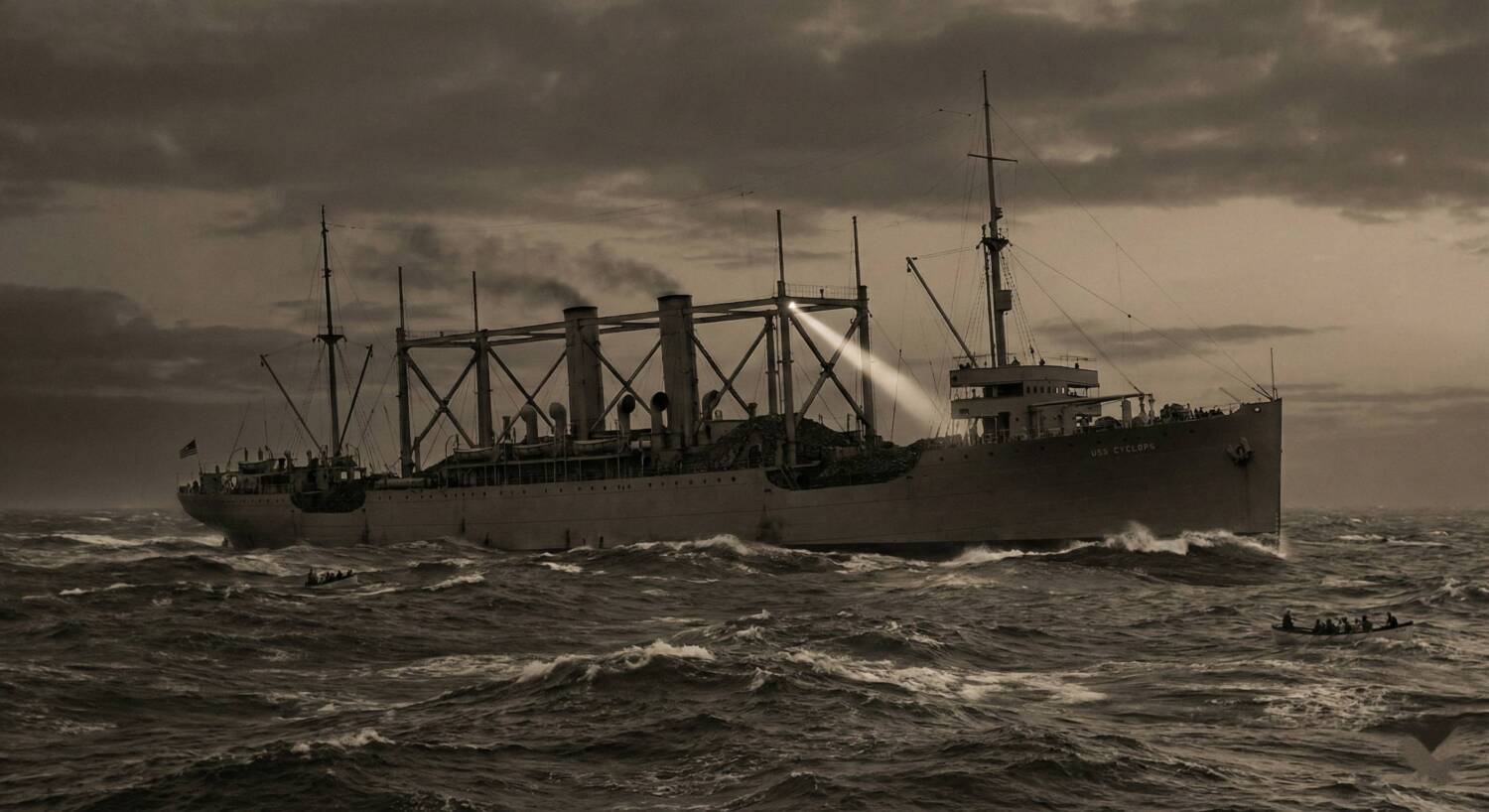

Long before the legend of the Bermuda Triangle became a household term, one of the most baffling disappearances in naval history had already taken place. The USS Cyclops, a massive U.S. Navy cargo ship, vanished in March 1918 with more than 300 people on board. To this day, it remains the single largest non-combat loss of life in U.S. Naval history, and one of the most enduring maritime mysteries ever recorded.
Commissioned in 1910, the USS Cyclops was a Proteus-class collier designed to carry large quantities of coal to refuel naval ships at sea. Measuring more than 540 feet long, it was a formidable vessel equipped for long voyages across the Atlantic. When the United States entered World War I, the ship was assigned to transport manganese ore, an essential component in steel production.
In February 1918, the Cyclops left Rio de Janeiro, Brazil, bound for Baltimore, Maryland. Its cargo hold was filled with manganese ore, and 309 crew members and passengers were aboard. The ship made one brief stop in Barbados for supplies before setting off on its final leg. It was never seen again.
The Vanishing USS Cyclops
No distress call was ever received. No wreckage, debris, or bodies were ever found. Despite an extensive search by the U.S. Navy, not a single piece of the ship’s remains was located. The disappearance was so complete that then-President Woodrow Wilson famously said, “Only God and the sea know what happened to the great ship.”
The sudden loss of such a massive vessel, with no storm warnings or enemy activity reported in the area, baffled investigators. The Cyclops’s last known communication was routine, indicating no sign of trouble.
Theories Behind the Disappearance
Over the years, numerous theories have attempted to explain the fate of the Cyclops. Some historians believe that the ship may have suffered a catastrophic structural failure. Its immense manganese cargo could have shifted during rough seas, destabilizing the hull and causing it to capsize suddenly. Others speculate that a German U-boat may have attacked the ship during wartime, though no evidence of such an encounter has ever been found.
More speculative explanations point toward supernatural or extraterrestrial causes, linking the Cyclops’s disappearance to what would later be called the Bermuda Triangle. Some claim the ship was drawn into a magnetic or gravitational anomaly, while others suggest it crossed paths with a portal to another dimension.
Legacy and Lasting Impact
The loss of the USS Cyclops cast a long shadow over naval history. Two of its sister ships, the Proteus and Nereus, would later vanish under similar mysterious circumstances in the same region during World War II, deepening the mystery. Despite modern sonar mapping and exploration of the ocean floor, no confirmed trace of the Cyclops has ever been found.
Whether it was a tragic accident, a wartime casualty, or something far stranger, the fate of the USS Cyclops continues to intrigue researchers and storytellers alike. It stands as one of the earliest and most haunting mysteries tied to the Bermuda Triangle.