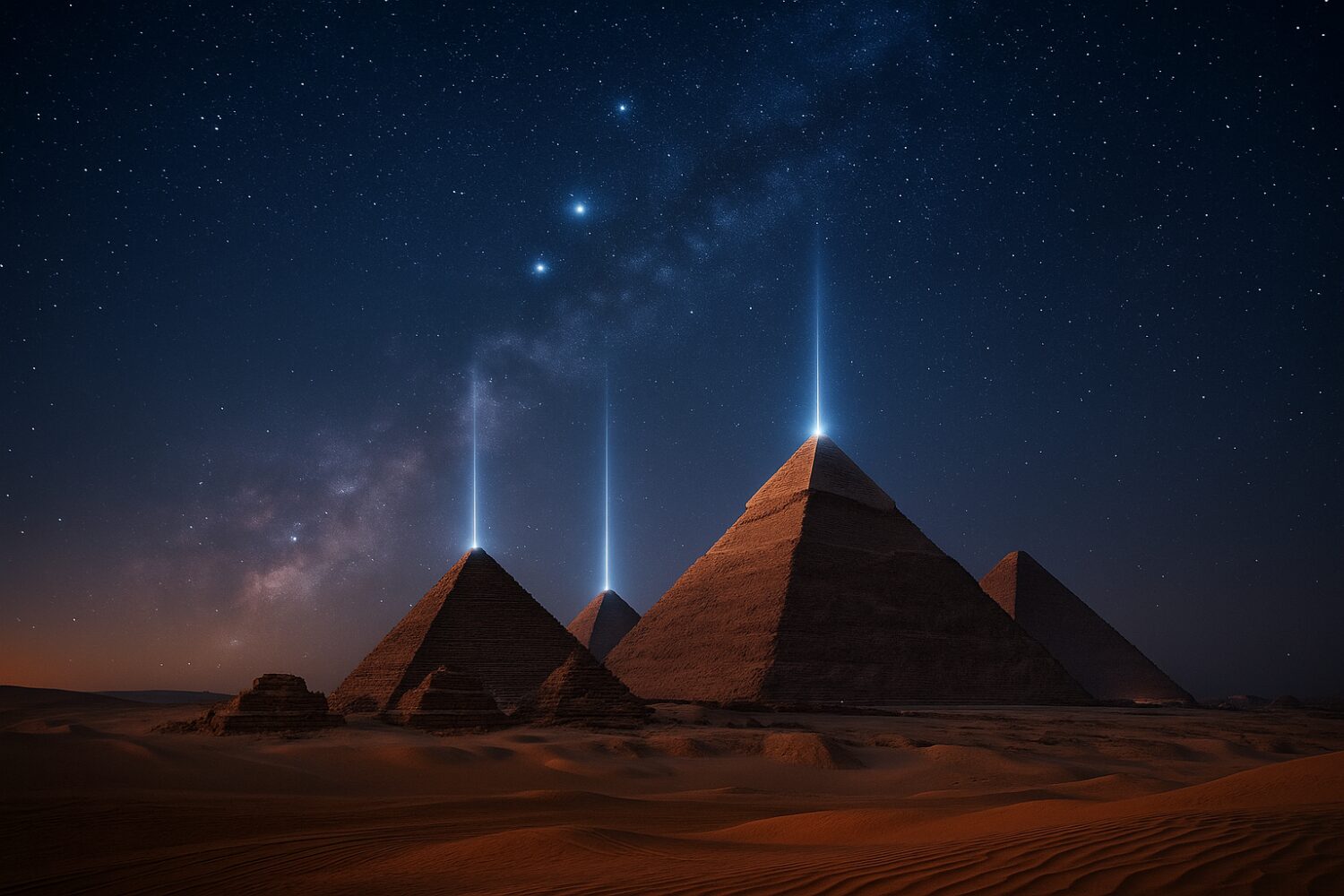
The Pyramids of Giza have stood for over four and a half thousand years, watching the desert sands shift around them. Rising from the Giza Plateau just outside modern Cairo, these colossal structures have long been more than simple tombs. They represent the pinnacle of ancient Egyptian engineering, spirituality, and cosmic understanding. Yet, despite centuries of research, they continue to guard secrets that modern science has only begun to uncover.
The Triad of the Gods and Kings
The Giza complex consists of three great pyramids built for Pharaohs Khufu, Khafre, and Menkaure. The largest, Khufu’s pyramid, once soared to nearly 147 meters. It was crafted from over two million massive stone blocks aligned so precisely that the entire structure points almost perfectly to the cardinal directions. Scholars believe this alignment was intentional, a reflection of the Egyptians’ astronomical mastery and their deep connection to the stars.
Khafre’s pyramid, slightly smaller but resting on higher ground, is accompanied by the Great Sphinx — a monument whose lion body and human face gaze eternally eastward. Menkaure’s pyramid, the smallest of the three, is distinguished by its pink granite casing and delicate proportions, perhaps suggesting a refinement of design rather than a reduction of ambition.
Engineering Beyond Time
The methods used to build the pyramids remain one of archaeology’s most persistent enigmas. Ancient records are silent on the techniques, leaving modern experts to speculate. Theories range from straight and circular ramps to complex counterweight systems and ingenious water-based methods. Recent archaeological evidence reveals worker villages and supply routes, suggesting that the pyramid builders were not slaves but skilled laborers who lived and died by the rhythm of royal construction.
Still, no definitive evidence explains how stones weighing up to fifteen tons were lifted hundreds of feet into the air with such precision. The Great Pyramid’s internal passages and perfectly aligned chambers continue to astonish engineers and physicists alike. Even today, its construction would challenge modern technology.
The Cosmic Connection
Many researchers and mystics alike believe the Pyramids of Giza serve more than an earthly purpose. Some theories suggest they were built as a reflection of Orion’s Belt — a celestial mirror designed to unite the heavens and the Earth. Others point to the so-called air shafts within the Great Pyramid, which align with key stars associated with the afterlife. Could the pyramids be more than tombs? Were they designed as cosmic gateways for the soul of the pharaoh to ascend into the stars?
Modern scanning technologies have detected unexplained voids deep within the Great Pyramid. One of these, discovered in 2017, is a vast hidden cavity above the Grand Gallery whose purpose remains unknown. It might be a structural chamber or something deliberately concealed by the ancient architects — a message meant for a distant future.
The Living Mystery
The Great Pyramids of Giza are the last surviving wonder of the ancient world. Despite their age, they remain remarkably preserved, still resonating with mathematical, spiritual, and astronomical significance. Whether seen as monuments to divine kingship or as conduits between worlds, the pyramids remind us of a civilization whose knowledge may have reached far beyond what we imagine today.
Perhaps the truest mystery of the Pyramids of Giza is not how they were built, but why they continue to capture our imagination — whispering through time, calling us to look upward toward the same stars that guided their makers.