

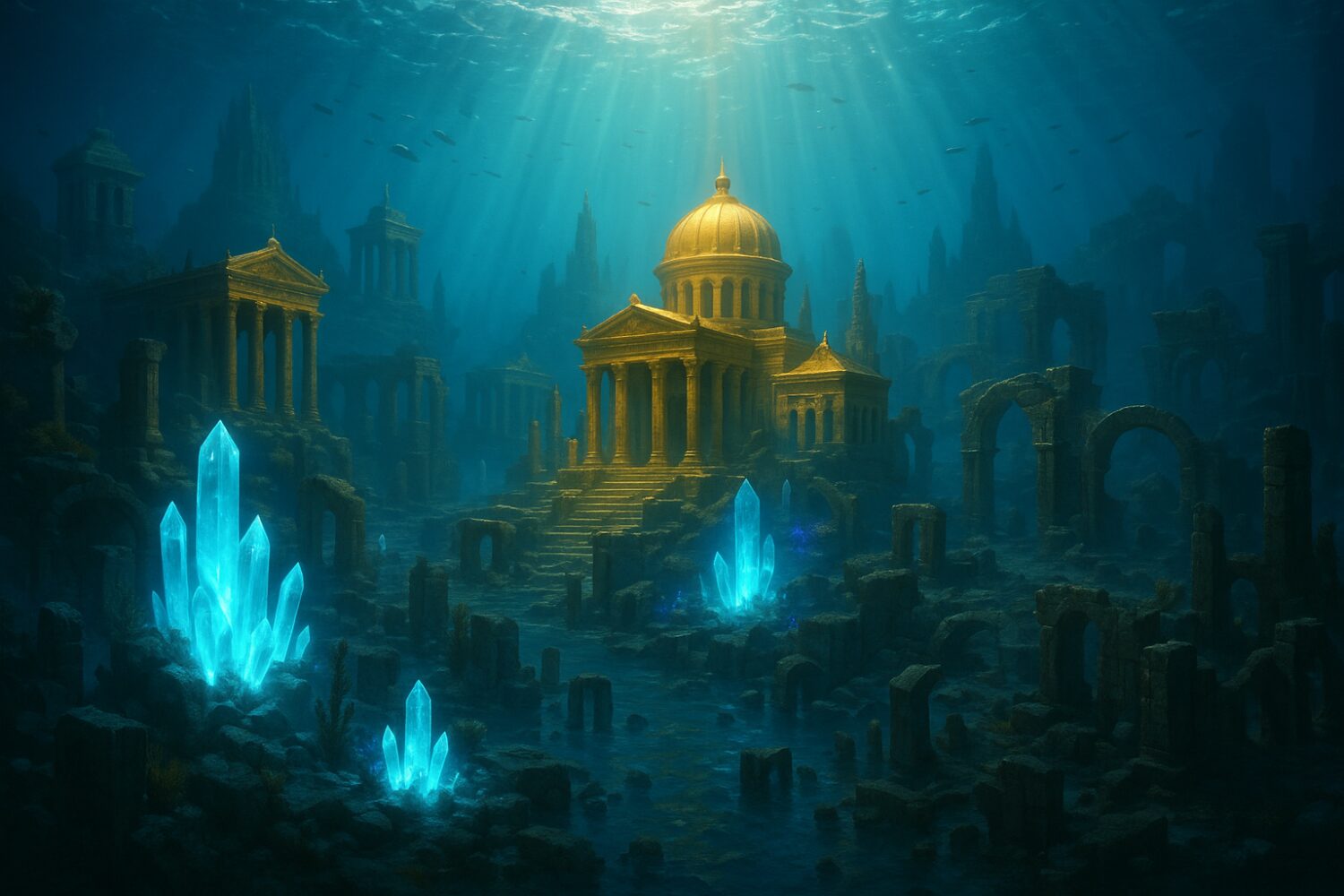

The legend of the Lost City of Atlantis has fascinated explorers, philosophers, and dreamers for centuries. Said to be a mighty and advanced civilization swallowed by the sea, Atlantis stands as one of humanity’s most enduring enigmas. The story first appeared in the writings of the ancient Greek philosopher Plato around 360 BCE, in his dialogues Timaeus and Critias. According to him, Atlantis lay beyond the Pillars of Hercules (known today as the Strait of Gibraltar), and was a vast island larger than Libya and Asia combined.
Plato described Atlantis as a paradise blessed by the gods. Its people were noble and wise, and their cities glimmered with gold, silver, and a mysterious metal called orichalcum. Canals, bridges, and grand temples filled their landscape, showcasing advanced engineering far ahead of its time. The Atlanteans were masters of the sea, commanding powerful fleets and controlling trade across much of the known world. Yet, their success led to corruption. Greed and pride consumed them, and the gods, angered by their arrogance, brought about their destruction. In a single day and night, Atlantis vanished beneath the waves.
For thousands of years, scholars have debated whether Atlantis was real or symbolic. Some believe Plato used it as a moral story about the dangers of human ambition. Others insist it was based on an actual place — perhaps the Minoan civilization on Crete or the island of Santorini, which was destroyed by a volcanic eruption around 1600 BCE. The eruption, followed by massive tsunamis, wiped out cities and could easily have inspired tales of a powerful empire lost to the sea.
Despite countless theories, Atlantis has never been found. Explorers have searched the depths of the Atlantic Ocean, the Caribbean, and even beneath the ice of Antarctica. Each new discovery of ancient ruins or underwater formations sparks renewed hope, yet none have provided conclusive proof. Some modern thinkers suggest that time, erosion, and shifting tectonic plates may have erased all evidence of Atlantis long ago. Others believe we simply haven’t looked in the right place.
Many alternative researchers and spiritualists claim Atlantis was more than just an advanced society — that its people possessed incredible knowledge of energy, crystals, and even cosmic forces. They suggest the Atlanteans could have harnessed natural energy or had connections with beings from beyond our world. While such ideas remain unproven, they continue to captivate those who believe in lost ancient wisdom and forgotten technology.
Whether Atlantis was a real civilization, a symbolic tale, or something in between, its story continues to inspire curiosity and wonder. The mystery endures because it speaks to something deep within us — the desire to uncover humanity’s forgotten past, and to believe that somewhere beneath the waves, a piece of our greatest secret history still waits to be found.