

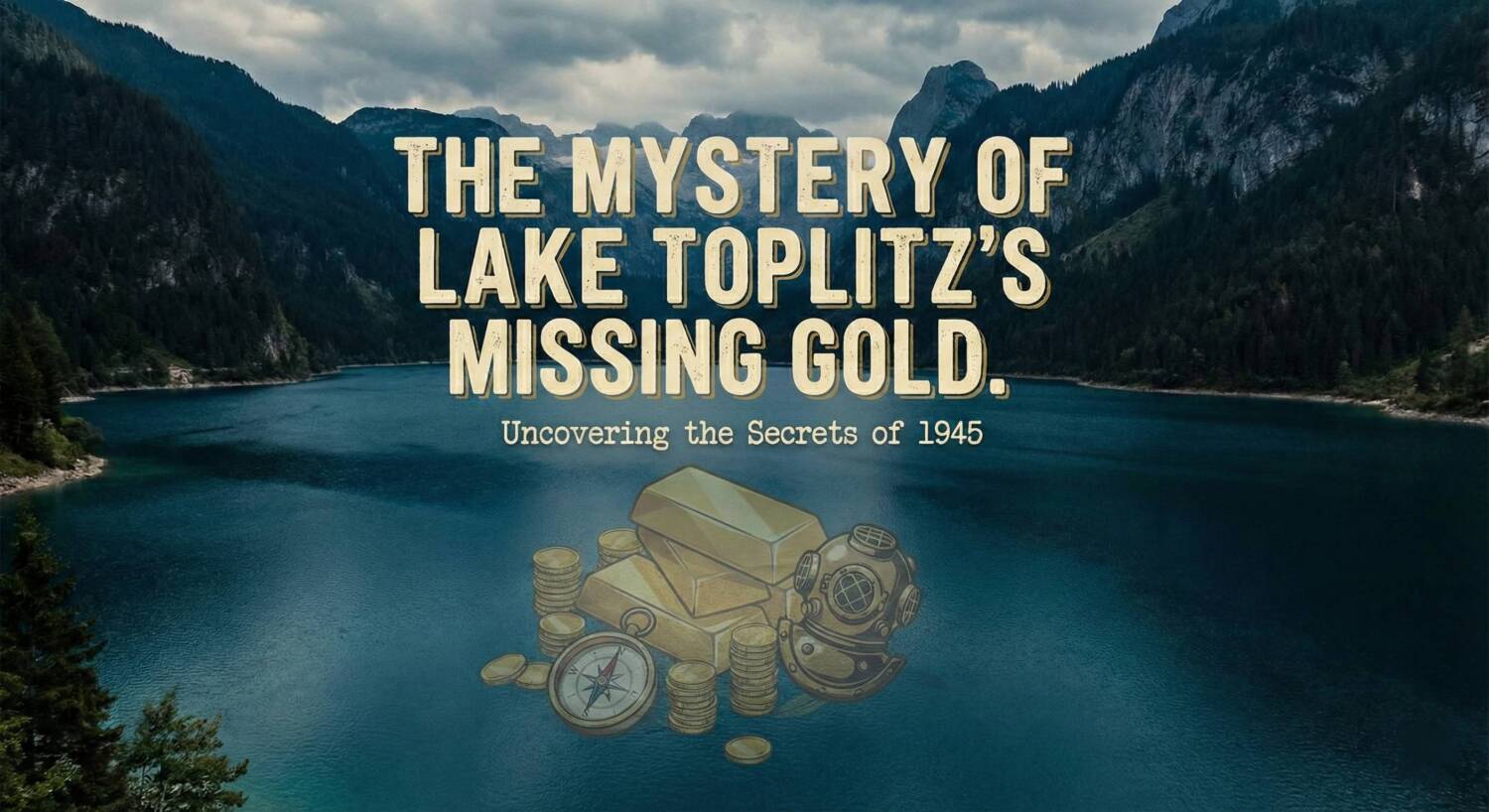

Lake Toplitz, an isolated alpine lake in Austria’s Salzkammergut region, has been the subject of fascination and mystery for decades. Hidden among steep cliffs and dense forests, the lake was used by the German Navy during World War II for secret testing and as a remote site where the Nazis could operate without drawing attention. What happened in those final days of the war, however, has given the lake a reputation far beyond its natural beauty.
In 1945, as the Allies advanced through Europe and the Third Reich collapsed, the SS allegedly transported a number of sealed wooden crates to Lake Toplitz. Witnesses from nearby villages later recalled seeing German soldiers unloading the boxes under guard and rowing them out onto the dark surface of the lake before pushing them overboard. It was said that some of these crates contained forged British banknotes from Operation Bernhard, a covert Nazi plan designed to destabilize the British economy by flooding it with counterfeit currency. The rest, however, were rumored to contain gold bars, valuable art, and important documents meant to fund postwar escape efforts or conceal evidence of wartime crimes.
Operation Bernhard itself was a remarkably sophisticated enterprise. Skilled counterfeiters, many of them prisoners forced into service, produced fake five, ten, and fifty-pound notes that were nearly indistinguishable from genuine currency. The plan aimed to undermine the British financial system, and for a time, it succeeded in introducing large amounts of counterfeit money into circulation. When the war ended, the Allies discovered the operation but never accounted for all of the forged notes. Lake Toplitz, with its secluded location and deep, cold waters, was the perfect place to dispose of the remaining evidence.
After the war, word of the dumped crates spread quickly. The first diving expeditions began in the 1950s, when divers recovered bundles of counterfeit currency wrapped in waterproof paper from the lake’s depths. These discoveries confirmed that the Nazis had indeed used the site to hide the products of Operation Bernhard, but they also deepened the mystery. The recovered boxes contained no gold, jewels, or art—only paper. Still, rumors persisted that not all of the crates had been found. Many believed the more valuable cargo lay buried deeper, beneath thick layers of silt and decaying logs that had sunk to the bottom over centuries.
Exploring Lake Toplitz has always been dangerous. Beneath roughly 20 meters, the water becomes toxic and devoid of oxygen, making it impossible for most forms of life to survive. The deeper layers are filled with rotting tree trunks that have fallen into the water from the surrounding forests, forming a tangled maze that can trap divers and equipment. Over the years, several treasure hunters have lost their lives trying to reach the bottom. Even with modern sonar and submersible technology, visibility remains poor, and sediment clouds easily obscure potential finds.
In the late 20th century, further expeditions took place, some sponsored by magazines and television networks eager to uncover lost Nazi gold. While divers found more counterfeit notes, rusted machinery, and naval testing equipment, they uncovered no sign of the fabled treasure. Austrian authorities eventually restricted exploration, citing safety concerns and environmental preservation. Yet despite official closure, the legend of Lake Toplitz refuses to fade. Stories continue to circulate about divers who secretly retrieved artifacts, shadowy groups that conducted unauthorized searches, and claims of sonar images showing large metallic objects still resting on the lakebed.
Skeptics argue that the Nazi gold story is nothing more than a postwar myth built around real but mundane discoveries. They point out that if the Nazis had intended to hide treasure, they would have chosen a more accessible location or taken the cargo with them into one of the many tunnels and salt mines known to have stored art and gold during the war. Others maintain that the lake’s remoteness and deadly depth make it the perfect hiding place for valuables that were never meant to be found.
Today, Lake Toplitz remains a place where history and legend overlap. It is both a site of documented wartime activity and a symbol of the countless secrets the Third Reich left behind. Whether it holds nothing more than counterfeit currency and decaying logs or the long-lost fortune of Nazi Germany, the mystery endures, preserved beneath layers of cold, silent water.