

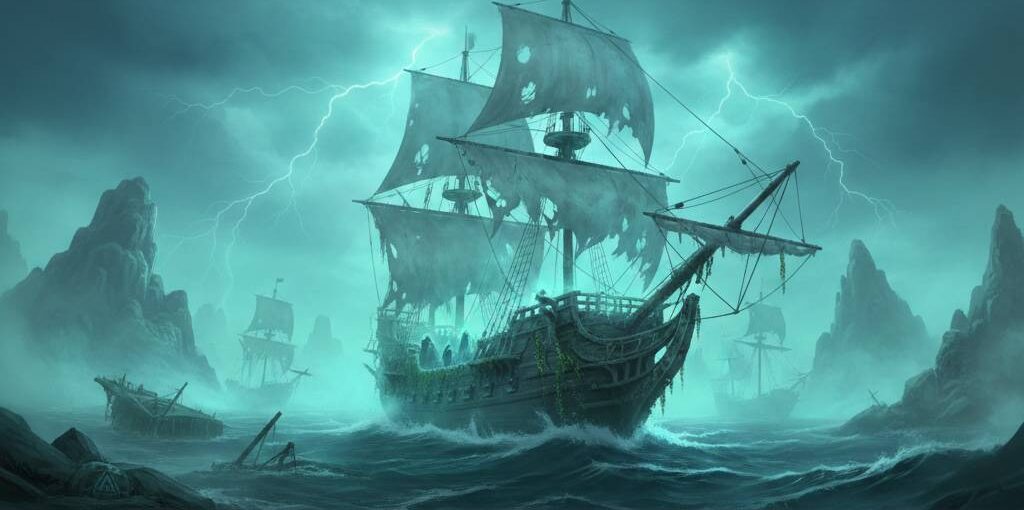
Of all the ghost ship stories connected to the Bermuda Triangle, few are as eerie or as well-documented as that of the Carroll A. Deering. When the massive five-masted schooner was discovered aground off Cape Hatteras, North Carolina, in January 1921, it was completely deserted. Its crew had vanished without a trace, leaving behind a mystery that remains unsolved to this day. The ship’s sudden abandonment, coupled with strange clues found on board, transformed it into one of the most iconic maritime enigmas in American history.
The Voyage and Discovery
The Carroll A. Deering was built in 1919 and owned by the G.G. Deering Company of Bath, Maine. It was considered a state-of-the-art schooner for its time, designed for long cargo runs. In August 1920, the vessel departed Norfolk, Virginia, bound for Rio de Janeiro with a shipment of coal. The journey there was uneventful, and after unloading its cargo, the ship began its return voyage to the United States in December of that same year.
On January 31, 1921, the Deering was spotted run aground on the treacherous Diamond Shoals, an area off Cape Hatteras often referred to as the “Graveyard of the Atlantic.” When rescue teams reached the ship several days later, they found a scene of bewildering normalcy—and total emptiness. The galley appeared ready for a meal, the lifeboats were missing, and the ship’s logbooks and navigation instruments were gone. However, there was no sign of struggle or damage that would explain a sudden evacuation.
The Mystery Deepens
The condition of the ship raised far more questions than answers. Why would an experienced crew abandon a sturdy vessel so close to home? There was no evidence of a storm in the area, nor any signs of piracy or conflict. Investigators noted that the ship’s emergency equipment had been neatly removed, suggesting an organized departure rather than a panicked escape. Even more mysterious was the lack of any trace of the crew—no bodies, lifeboats, or personal effects were ever found.
Adding to the intrigue, lighthouse keepers in the region reported strange sightings of a large schooner sailing erratically in the days before the discovery, suggesting that the Deering may have been adrift for some time before grounding. Some nearby vessels also claimed to have received unclear radio transmissions believed to come from the Deering, but none were ever confirmed.
Theories and Speculation
Numerous theories have emerged to explain what happened aboard the Carroll A. Deering. Some maritime historians suspect a mutiny—possibly spurred by tensions between the ship’s captain, W.B. Wormell, and his first mate. Others suggest piracy, perhaps by rum-runners operating during Prohibition. The idea of a rogue wave or sudden storm has also been proposed, though weather reports from the time do not support it.
More imaginative explanations quickly followed. As public fascination with the Bermuda Triangle grew decades later, many began to link the Deering’s disappearance to that mysterious region. Some writers suggested that the ship may have fallen victim to an electromagnetic anomaly or even a paranormal event, vanishing its crew while leaving the vessel behind. No evidence has ever substantiated these claims, but the story became deeply embedded in Triangle lore.
The Enduring Legend
The U.S. government conducted one of the largest maritime investigations in its history at the time, involving the Navy, the Coast Guard, and the FBI. Despite interviewing witnesses and examining every known lead, the inquiry ended without a definitive conclusion. The fate of the Deering’s crew remains an open question.
Today, the Carroll A. Deering stands as a chilling reminder of the sea’s enduring mysteries. Its ghostly image—silent, intact, and deserted—continues to haunt maritime historians and paranormal enthusiasts alike. Whether the result of mutiny, misfortune, or something more otherworldly, the Deering’s story remains one of the most enduring ghost ship legends in the Atlantic.
 Ghost Ships
 The Bermuda Triangle