
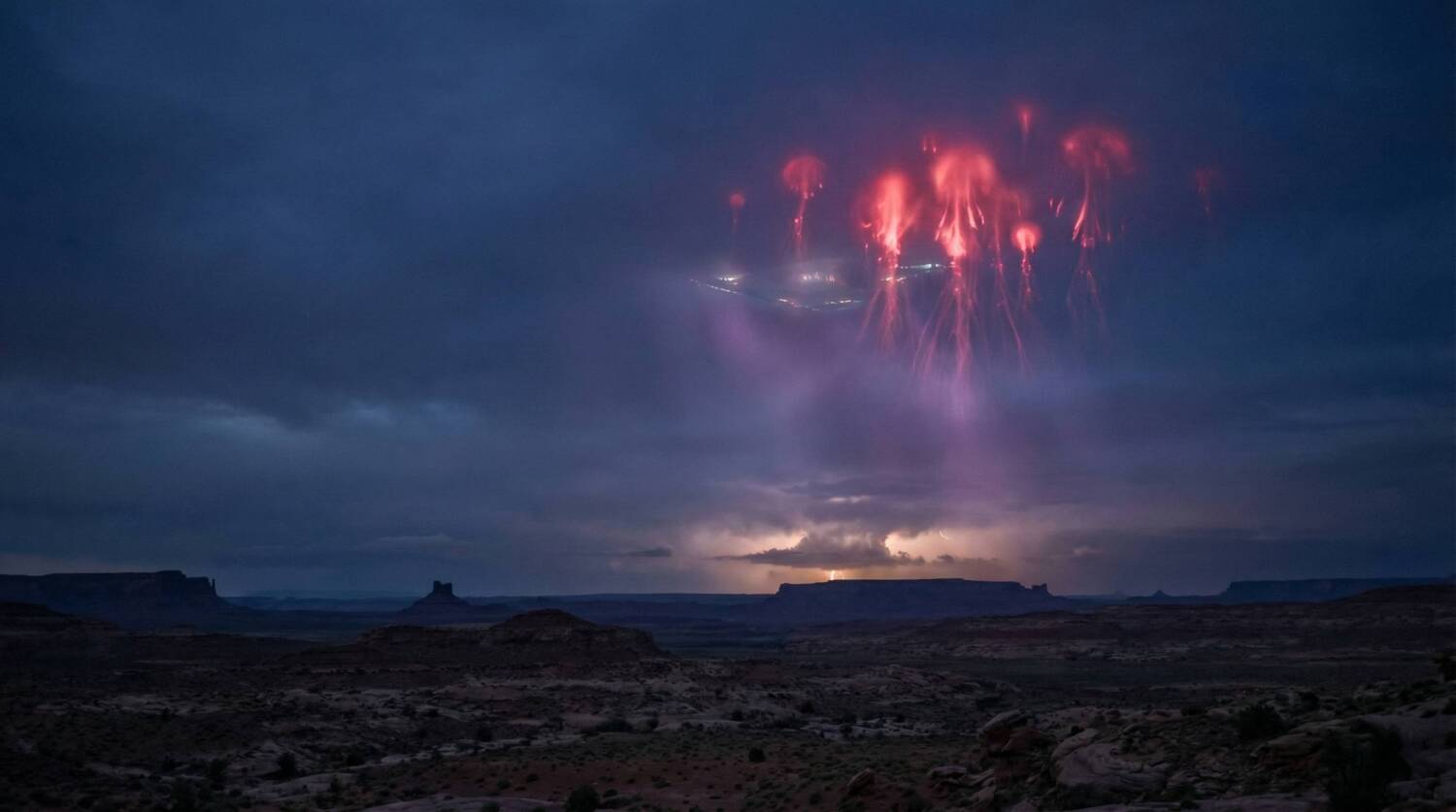
They flicker for a fraction of a second, high above thunderheads, in places where lightning can’t reach and satellites barely see. Red sprites, glowing, jellyfish-like flashes that dance at the edge of space, have puzzled scientists for decades. But in certain circles of alien research and skywatching, these lights are seen not as accidents of weather, but as intentional signals from somewhere beyond Earth.
No one can say for sure what these lights truly are, yet the patterns, timing, and sheer strangeness of them have inspired a theory that refuses to fade: that red sprites might be connected to extraterrestrial activity.
A Message Written in the Sky
One of the most popular interpretations among UFO theorists is that sprites could be part of a vast, energy-based communication system. Storms are among the most powerful natural generators of electricity on our planet. When they reach peak charge, something interacts, and suddenly a burst of red light appears far above, structured, symmetrical, and alive-looking.
To believers, that’s no coincidence. The idea is that extraterrestrial intelligences might be using Earth’s storms as transmitters, feeding or modulating energy fields to send messages across great distances. Each sprite, in that framework, isn’t just random static, but a brief “pulse”, a coded interaction between dimensions.
The Gateway Hypothesis
A more adventurous theory suggests sprites might mark gateways, temporary tears in the electromagnetic fabric of the upper atmosphere. These gateways could allow for the transfer of energy, matter, or even small craft between realities. The red light, then, would be a side effect of immense power focused through the thin upper layers of our air.
Those who support this view point out that sprites often appear in clusters, like a synchronized sequence rather than random lightning. Some claim they’ve seen patterns, spirals, lattice-like forms, and shapes that seem too organized to be chaotic plasma. Whether coincidence or design, it’s easy to see why people imagine something far more deliberate behind them.
Hidden in Plain Sight
If there were alien involvement, sprites would be the perfect cover. They’re natural-looking, rare, and difficult for ordinary people to observe. The average camera can’t capture them, and the few who can study them in detail are tied to government or research institutions. That’s an ideal setup for something to operate unseen, right under humanity’s nose, yet hidden behind the label of “weather phenomenon.”
Even among scientists who fully accept sprites as electrical discharges, there’s acknowledgment of how peculiar they are. The altitude, color, and shape of these events don’t resemble lightning in any familiar way. They appear, flare, and vanish with a grace that feels almost biological. To those who believe the cosmos is alive with intelligence, sprites look less like storms and more like signatures, luminous traces of activity we don’t yet understand.
Visitors Made of Light
In some branches of alien folklore, there’s the idea that not all life forms require bodies as we know them. Some could exist as pure energy, electromagnetic consciousness that manifests through plasma or charged particles. To people who hold this belief, red sprites are a possible clue that such entities are real, visitors composed not of flesh and metal, but of the same glowing substance as lightning itself.
If that’s true, then sprites wouldn’t just be communication signals or doorways, they would be the visitors. Living forms of energy feeding on atmospheric tension, surfacing only when storms reach the right intensity to sustain them.
The Mystery That Refuses to Fade
Whether viewed through a scientific lens or a cosmic one, red sprites remain hauntingly beautiful. They appear high in the sky, pulsing silently, as if nature itself were sending a message too vast to decode.
For alien theorists, they stand as one of the most tantalizing possibilities yet: proof that the universe might be reaching out, not through radio signals or flying saucers, but through the language of light itself.
 Red Sprites (Red Jellyfish)