

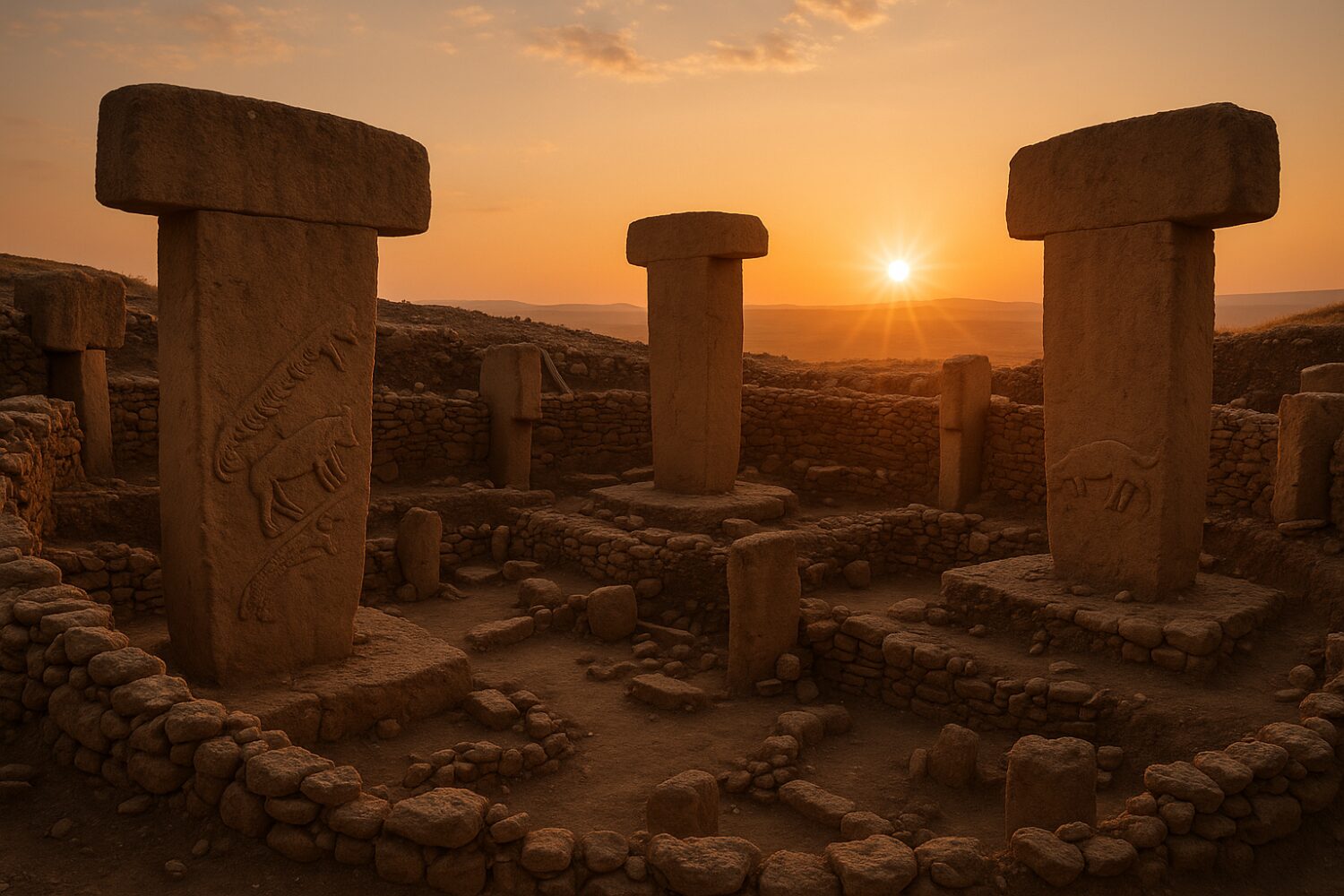

High on a barren hilltop in southeastern Turkey lies Göbekli Tepe, an archaeological site that has rewritten the story of civilization. Its name means “Potbelly Hill,” but the unassuming mound hides something far more extraordinary: a complex of stone circles and towering pillars built more than 11,000 years ago. That makes it older than Stonehenge by over 6,000 years and predating the Great Pyramids of Egypt by almost twice that. Yet its builders were not farmers or city dwellers, but nomadic hunter-gatherers living long before the rise of agriculture.
Excavations at Göbekli Tepe began in the 1990s under the direction of German archaeologist Klaus Schmidt. What he uncovered stunned the academic world. Beneath the soil were massive T-shaped megaliths arranged in circular enclosures. The largest pillars stand nearly 6 meters tall and weigh up to 20 tons, each carved from solid limestone. Many are decorated with intricate bas-reliefs depicting wild animals—lions, snakes, foxes, vultures, and boars, as well as abstract symbols whose meaning remains unknown. These carvings display artistic mastery and spiritual intent, suggesting that Göbekli Tepe served as a ceremonial or religious center, possibly the world’s first temple.
What makes Göbekli Tepe so enigmatic is not only its age but also the people who built it. At the time of its construction, humans had not yet developed farming, pottery, or permanent settlements. According to traditional understanding, complex religious architecture should only appear after the agricultural revolution, when stable communities could support large-scale projects. Yet Göbekli Tepe turns that logic upside down. It suggests that the impulse for belief and ritual may have inspired humans to gather, organize, and eventually farm, rather than the other way around.
The site’s purpose remains a mystery. No evidence of domestic life—no houses, no hearths—has been found nearby. Instead, archaeologists discovered stone tools, animal bones, and ritual artifacts, pointing to feasting and ceremonial activity. The recurring animal motifs might represent totemic spirits or deities, perhaps connected to early shamanistic traditions. Some researchers even propose that the circular enclosures symbolized the cosmos, with the central pillars representing divine beings or ancestors.
Equally baffling is the fact that Göbekli Tepe was deliberately buried around 8000 BCE. The massive enclosures were filled in with soil and debris, preserving them almost perfectly. No one knows why. Some believe the burial was intentional, possibly part of a closing ritual to mark the end of an era. Others suspect environmental change or cultural transformation forced its abandonment. Whatever the reason, this act protected Göbekli Tepe from erosion and looting for millennia until its rediscovery in the modern era.
Modern technology has only deepened the mystery. Ground-penetrating radar reveals that what we see is only a fraction of the site, dozens more enclosures still lie buried. Each new discovery challenges our assumptions about the origins of religion, art, and organized society. Göbekli Tepe is not merely an ancient ruin; it is a message from humanity’s distant past, a reminder that the roots of belief stretch back further than anyone imagined.
Whether it was a temple for gods, a meeting place for clans, or a portal to another realm, Göbekli Tepe stands as a silent monument to a forgotten age. Its builders, long vanished, left behind no written record—only stone sentinels staring into eternity, daring us to remember who we once were.