

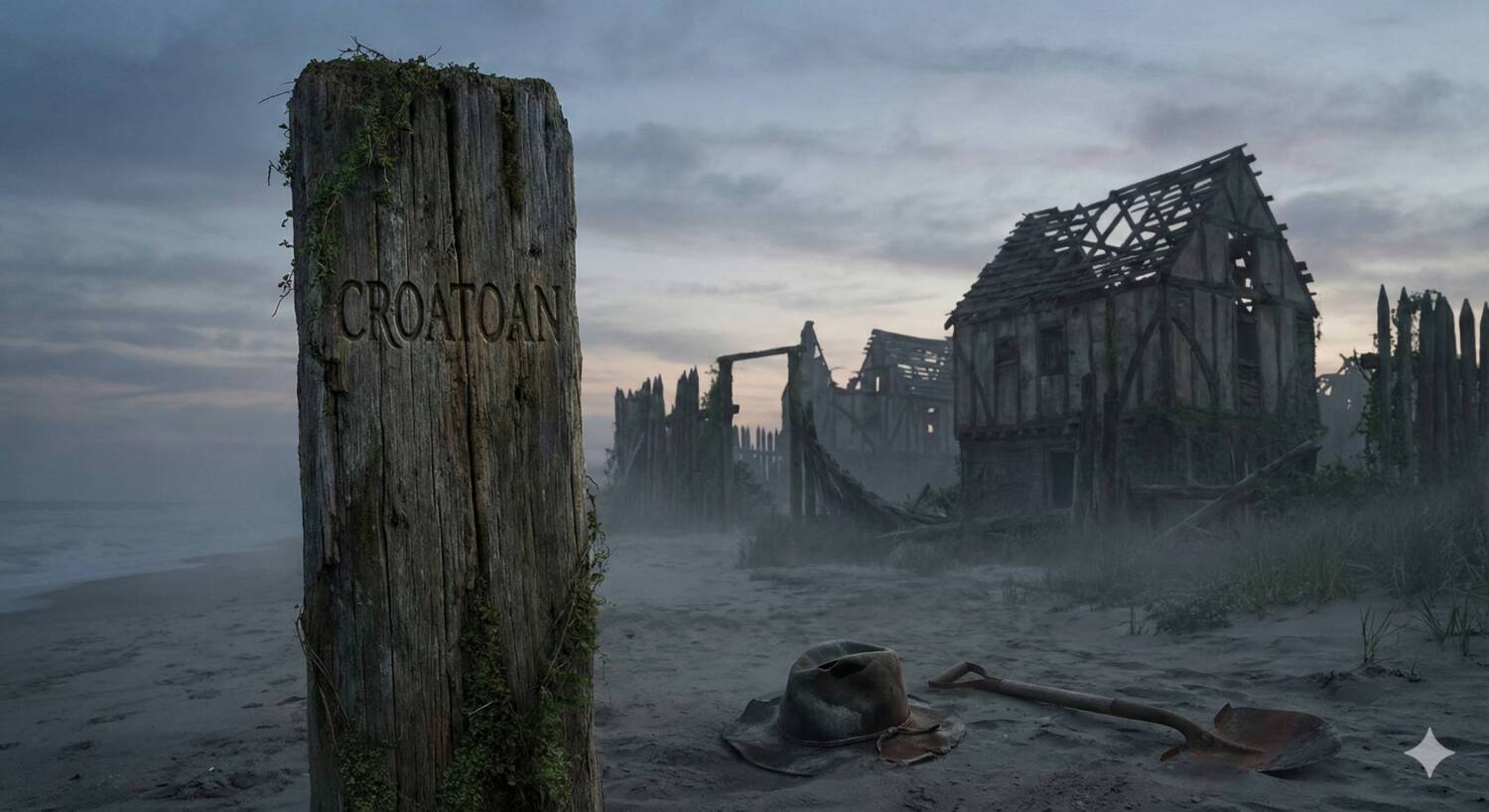
The Lost Colony of Roanoke remains one of the most confounding and chilling mysteries in American history. When Governor John White returned to Roanoke Island in 1590, he expected to find a growing settlement of English families carving out a new life in the New World. Instead, he found the colony deserted. Homes were dismantled, fortifications taken down, and every sign of life erased. There were no bodies, no graves, no signs of violence—only a single word carved into a wooden post: CROATOAN.
For centuries, historians and researchers have tried to explain what happened to the 115 men, women, and children who vanished. Many theories seem plausible on the surface, yet when examined closely, they fall apart under the weight of missing evidence. How could over a hundred people disappear completely, leaving behind no trace of where they went—or how they died?
The Problem with Logical Explanations
Most of the conventional theories about Roanoke’s fate rely on logic. Perhaps the colonists were attacked, starved, or relocated. But each explanation opens new questions that history has failed to answer.
1. If They Were Killed, Where Are the Bodies?
One of the oldest explanations is that the colonists were attacked—either by hostile tribes or rival European powers like Spain. Yet, if a massacre took place, where are the remains? No bones, weapons, or signs of conflict have ever been found at the site. The ground yielded no evidence of mass graves or burned structures. Even the wooden fortifications were carefully dismantled, not destroyed in battle. Everything points to an orderly departure, not a violent end.
Some records from Jamestown decades later mention rumors of slain settlers, but these stories were vague and unsupported. It is almost as though the colonists simply walked away, taking their possessions—and their very existence—with them.
2. If They Starved, Why Didn’t Nature Leave a Trace?
Others suggest that famine and disease wiped out the settlement. While this is certainly possible, starvation leaves behind a grim signature—bones, makeshift graves, or abandoned tools. Yet Roanoke revealed none of these. The colony site showed signs of deliberate disassembly, not panic or decay. The settlers’ homes were taken apart as though they planned to move elsewhere. Starvation is rarely neat, but Roanoke’s disappearance was disturbingly clean.
3. If They Moved, Where Did They Go?
Many historians believe the colonists relocated to Croatoan Island (modern-day Hatteras) or inland toward the Chesapeake Bay. But despite centuries of searching, archaeologists have never found definitive proof that the colonists successfully resettled. A handful of English artifacts have surfaced in both areas, but none can be confirmed to have belonged to the Roanoke settlers specifically. If they did survive, they left behind no writings, no graves, no cultural record—nothing to prove their continued existence.
Even more unsettling, if they joined local tribes, why didn’t later explorers encounter their descendants or hear detailed stories about their fate? Indigenous oral traditions mention the English, but never the specifics of their disappearance. It is as if their memory, too, was erased.
The Silence That Shouldn’t Exist
Perhaps the most haunting detail of all is the absence of chaos. When White arrived, he found a settlement that had been deliberately taken apart, not destroyed. No signs of a struggle, no blood, no personal belongings scattered in haste. Whatever happened, it happened with eerie precision. The settlers didn’t vanish in an instant—they vanished deliberately, silently, and completely.
Even the word CROATOAN carved into the post raises more questions than it answers. If it was a clue, why didn’t anyone follow it? If it was a warning, who was it meant for? And why was it the only sign left behind, without any accompanying symbol or explanation?
Theories Beyond Reason
When logical explanations collapse under the weight of evidence, or lack thereof, stranger ideas rise to the surface. Some believe that Roanoke was cursed, that the land itself rejected the settlers. Others whisper that the word “Croatoan” was not a message, but a mark—a sign of a supernatural event that consumed the colony.
In the centuries since, the word “Croatoan” has been linked to other eerie events: mysterious disappearances, unexplained deaths, and places that seem to absorb those who wander too far. To some, it represents a boundary—between worlds, between history and myth, between reason and the unknown.
How Does a Colony Vanish?
We may never know what happened to the people of Roanoke Island. They could have died of hunger, disease, or conflict. They could have been absorbed by another tribe. But the evidence does not fit neatly into any of these explanations. No matter how rational the theory, it cannot explain how an entire colony could disappear so completely—without bones, without wreckage, without a single trace of struggle.
What remains is silence, an empty settlement, and one enigmatic word that has echoed through history. Perhaps the colonists did not merely disappear—they were taken by something that leaves no trace at all.
 The Lost Colony of Roanoke